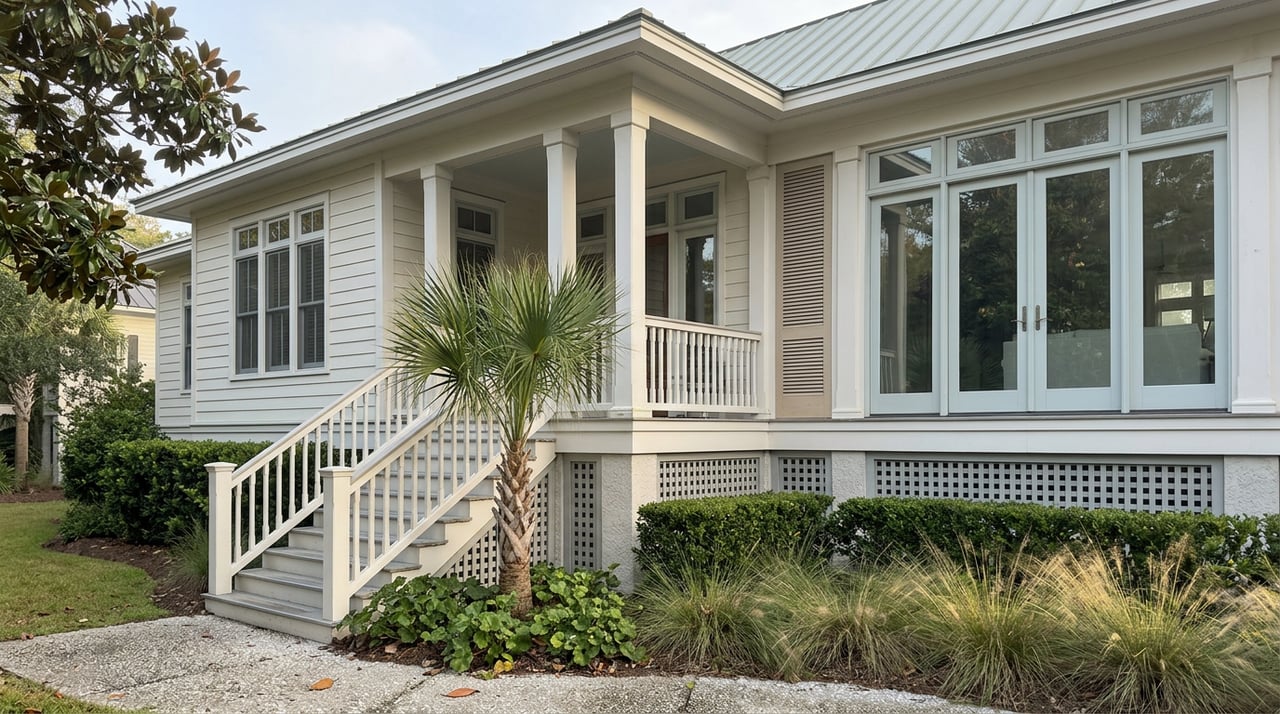
Johns Island Median Price: New Construction vs Acreage
September 10, 2026
September 10, 2026
A buyer touring a marsh-front listing on Johns Island this summer assumed the view came with a dock. It didn't, at least not automatically. Dock rights on Johns Island aren't decided by the listing photos or even the seller's disclosure. The South Carolina Department of Health and Environmental Control makes that call, and it depends on two things that have nothing to do with the house: how wide the waterway is at that exact property line, and whether a previous owner already built a dock there. No existing dock, no guarantee one gets approved later. Buyers who assume marsh frontage equals boat access sometimes find out otherwise after they're under contract.
That single detail is a useful warning before you look at anything else about this market, because the same pattern shows up in the number every buyer sees first: the median price. On Johns Island, that number looks solid on a portal page. It isn't. It's an average of two markets that happen to share a zip code and very little else.
Pull three snapshots from 2026 and you get three different answers. In the three months ending in May 2026, homes here sold for a median of $660,000, up 7.3 percent from the same period a year earlier. A month later, one broader market read put the June 2026 median at $729,999, with 422 homes actively listed and price per square foot running around $316. By September 2026, another tracker had the median at $725,000 across roughly 1,159 sales over the trailing twelve months.
That's nearly a $70,000 spread depending on which month and which slice of the market you catch. Normally that would just be noise between data sources. On Johns Island it's a symptom. When a single geography is producing wildly different medians depending on the exact window you measure, it usually means the underlying inventory isn't one product. It's two, blended into a single line on a spreadsheet.
Here's the split. On one side sit the planned communities: Kiawah River, Stonoview, Sea Island Preserve. On the other sit non-gated acreage and individual waterfront parcels along corridors like River Road and Bohicket Creek, plus older established neighborhoods such as Headquarters Plantation.
| Amenity Communities (Kiawah River, Stonoview, Sea Island Preserve) | Land and Acreage (Headquarters Plantation, River Road, Bohicket Creek) | |
|---|---|---|
| Typical lot size | About a third to half an acre | One acre to 60-plus acres |
| What the price includes | Resort-style pool, community dock, HOA-maintained trails and grounds | Land itself, often with no covenants at all |
| Price range | $600s into the $2 million-plus range | Small residential lots run $150,000 to $400,000-plus; larger tracts run $500,000 to over $1 million, land only |
| HOA dues | Standard | Rare or nonexistent |
| Best fit | Buyers who want a finished, turnkey lifestyle | Buyers building custom or prioritizing privacy over amenities |
Kiawah River spans roughly 2,000 acres with 20 miles of waterfront, a working farm and goat pasture residents call the Goatery, a community dock, boat ramp, and a clubhouse with a pool. Sea Island Preserve pairs lots a third to half an acre with over 360 acres set aside for conservation, plus a pool, pickleball, and a putting green. Stonoview leans on deepwater access with its own community dock and pavilion. All three package the price around a finished lifestyle.
Drive the other direction and the same dollar figure buys something structurally different. Small residential lots on Johns Island run $150,000 to $400,000 or more depending on location and elevation, and that's before a house exists. Larger tracts, the kind suited to horses or genuine privacy, run $500,000 well past $1 million for the land alone. A buyer comparing a $700,000 finished home in an amenity community to $700,000 worth of raw acreage on Bohicket Creek isn't comparing two options in the same market. They're comparing a product to an input.
There's a second force stretching that median, and it comes from the opposite end of the price range. Reporting on Johns Island's luxury segment, covering year-over-year performance through early 2026, showed homes priced above $2 million selling up 18 percent compared to the prior year, with average luxury sale prices up 11 percent over the same stretch. That's a genuinely hot pocket of the market.
Meanwhile the middle of the market has been cooling, just more slowly. A separate summer 2026 read on the broader market showed days on market stretching from 69 days to 77 days year over year, even as the overall median kept climbing. Different windows, but the shape holds together: prices up while homes sit longer usually means fewer buyers are willing to move fast at every price point, while the ones buying at the top are moving anyway and pulling the average with them.
If you're shopping in the $600,000 to $800,000 range, luxury sales growth at the $2 million mark isn't evidence your segment is heating up in the same way. It's evidence the median you're reading is doing more work than a single number should.
Before treating "Johns Island median price" as a planning figure, it helps to know which of the two markets a specific listing belongs to and what the price is actually buying.
None of these questions show up in a median price. All of them determine whether that price is a fair one for what you're actually getting.
Is new construction on Johns Island cheaper than buying an older home? Not automatically. New construction in communities like Sea Island Preserve or Kiawah River bundles amenities and HOA-maintained infrastructure into the price. Raw acreage without a house can look cheaper upfront, but build costs on top of land in the $150,000 to over $1 million range change that comparison fast. The two aren't interchangeable options at the same price.
Does a Johns Island waterfront listing always include a dock? No. Dock ownership depends on permit eligibility through DHEC and whether a previous owner already built one. Eligibility is tied to the width of the waterway at that property line, among other site-specific factors. Confirm dock rights directly rather than assuming water frontage guarantees water access.
Why are prices rising if homes are taking longer to sell? The two trends aren't contradictory once you separate the market by price tier. Luxury sales above $2 million grew sharply year over year and pulled the average up, while the broader middle of the market saw buyers become more selective, which shows up as longer days on market. Both things can be true in the same set of year-over-year numbers.
If you're weighing a finished home in a planned community against acreage you'd build on, or trying to confirm what a specific waterfront parcel actually includes, that's exactly the kind of detail worth walking through before you write an offer. Kaylan Tyler works Johns Island regularly and can help you figure out which side of this market a given listing actually sits on. Schedule a consultation to start there.
Stay up to date on the latest real estate trends.

For an unmatched Charleston real estate experience tailored to your needs, reach out to Kaylan Tyler today. Let her passion and expertise guide you in finding or selling your dream home. Contact Kaylan now to begin your journey towards the perfect Charleston lifestyle!